


Thomas Wilson, MBCP, CPP
Certified Professional Photographer · San Francisco
Golden hour is not a time on the clock. It's a feeling — warm, fleeting, and utterly unforgiving to those who aren't ready for it. In 18 years of shooting across San Francisco, the Bay Area, and beyond, I've chased that light more times than I can count. And I've learned that the photographers who consistently nail it aren't lucky. They're prepared.
These are my field notes — the principles, habits, and hard-won lessons that help me make the most of those precious 45 minutes when the world turns gold.
1. Scout Before You Shoot
The single biggest mistake photographers make with golden hour is arriving at the location when the light does. By then, you're scrambling — checking angles, tripping over gear, missing the best moments while you're still figuring out where to stand.
I scout every outdoor location at least once before a session, ideally at the same time of day I'll be shooting. I note where the sun will be, which surfaces will catch and bounce the light, and where the shadows will fall. In San Francisco, the fog changes everything — a location that's bathed in gold one evening can be completely socked in the next. I always have a backup plan.
Apps like PhotoPills and The Photographer's Ephemeris are invaluable. They let you visualize exactly where the sun will set relative to your location on any given date. I use them religiously.
"The photographers who consistently nail golden hour aren't lucky. They're prepared."
2. Arrive 30 Minutes Early — Minimum
Golden hour doesn't start at sunset. The quality of light begins shifting 45 to 60 minutes before the sun touches the horizon. The soft, directional light you get in that window — before the sky turns orange and pink — is often my favorite of the entire session. It's warm but not overwhelming, and it wraps around faces in a way that's almost impossible to replicate in a studio.
I tell my clients to arrive 30 minutes before the light I want. That gives us time to settle in, get comfortable, and start shooting before the magic window opens. By the time the sky ignites, we're already in a rhythm — and I'm free to focus entirely on the light.
3. Expose for the Skin, Not the Sky
This is where a lot of photographers go wrong. They see that gorgeous sky and expose for it — which means their subject becomes a silhouette. Unless that's intentional, it's a mistake.
I always expose for my subject's skin first. I'll use exposure compensation to bring the sky down in post if needed, or I'll position my subject so the sky isn't competing with them. Sometimes I'll use a reflector to bounce a little fill light back onto the face — just enough to keep the shadows from going too deep.
Shooting in RAW gives you the latitude to recover highlights and lift shadows in post. But the best insurance is getting the exposure right in camera. I'd rather have a slightly blown sky than a muddy face.
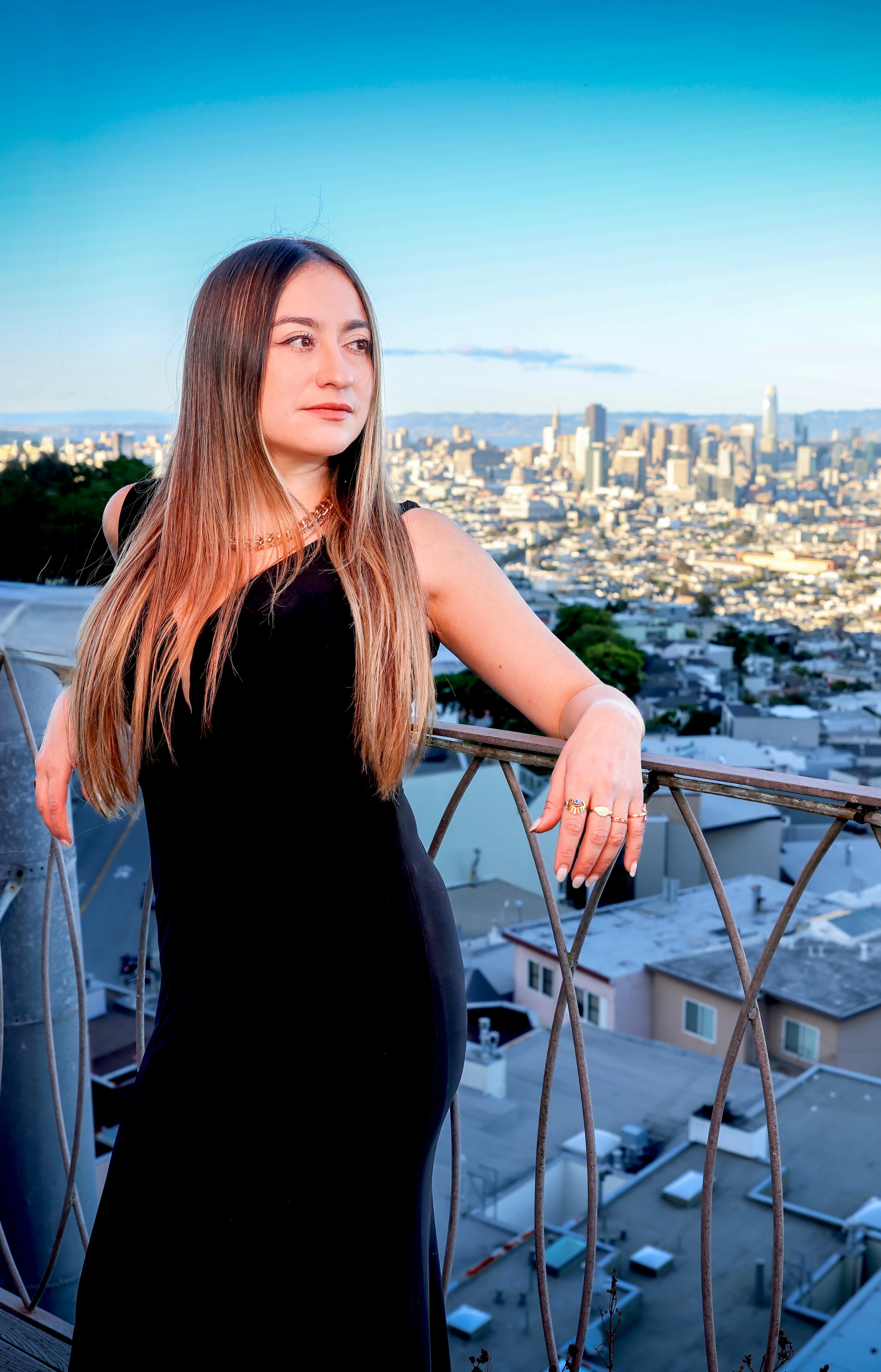
Golden hour on a San Francisco rooftop — the city skyline becomes part of the story.
4. Use the Sun as a Rim Light
One of my favorite techniques during golden hour is placing the sun just behind and to the side of my subject. This creates a beautiful rim or hair light — a warm glow that separates them from the background and gives the image a cinematic, three-dimensional quality.
The key is to keep the sun just out of frame, or to use your subject's body to block the direct light from hitting your lens. A little lens flare can be gorgeous — but uncontrolled flare will wash out your image and kill your contrast.
I'll often shoot a series of frames while slowly adjusting my angle relative to the sun, watching how the rim light changes. Sometimes the most beautiful frame is the one where the light is just barely kissing the edge of a cheekbone.
5. Keep Moving — The Light Won't Wait
Golden hour moves fast. In San Francisco, where the sun can drop behind the hills or disappear into the fog with almost no warning, I've learned to work quickly and decisively. I don't spend five minutes perfecting one pose when the light is changing every 30 seconds.
I keep my clients moving — walking, turning, looking away and back. Movement creates natural, authentic expressions and keeps the energy of the session alive. And when the light shifts, I shift with it. I might move 20 feet to the left to catch a new angle, or ask my subject to turn slightly to catch the last rays before the sun drops.
The photographers who get the best golden hour images are the ones who stay fluid. Rigidity is the enemy of great light.
The Light Is Always Worth Chasing
After 18 years, golden hour still stops me in my tracks. There's something about that quality of light — the way it softens everything, the way it makes ordinary moments feel extraordinary — that never gets old. It's one of the reasons I fell in love with photography in the first place.
If you're planning a portrait session and you want that warm, luminous quality, let's talk about timing your shoot around the light. It makes all the difference — and I'll make sure we're ready for it.
Ready to Chase the Light?
Let's Plan Your Session
Every session I book is timed around the best available light. Let's create something extraordinary together.
Book a Consultation